
By: Ethan Barrocas
Taylor Swift’s twelfth studio album attempts to create glittering grandeur. Unfortunately, at times it’s subdued, unlayered, and even embarrassing for the global superstar.
Taylor Swift’s career has spanned many eras. Each of the eleven is distinct, yet still manages to provide some sort of consistency and variety. We’ve had the autumnal excellence of evermore to the late-night introspection on Midnights. And now, on October 3rd, 2025, Taylor entered her twelfth era, The Life of a Showgirl.
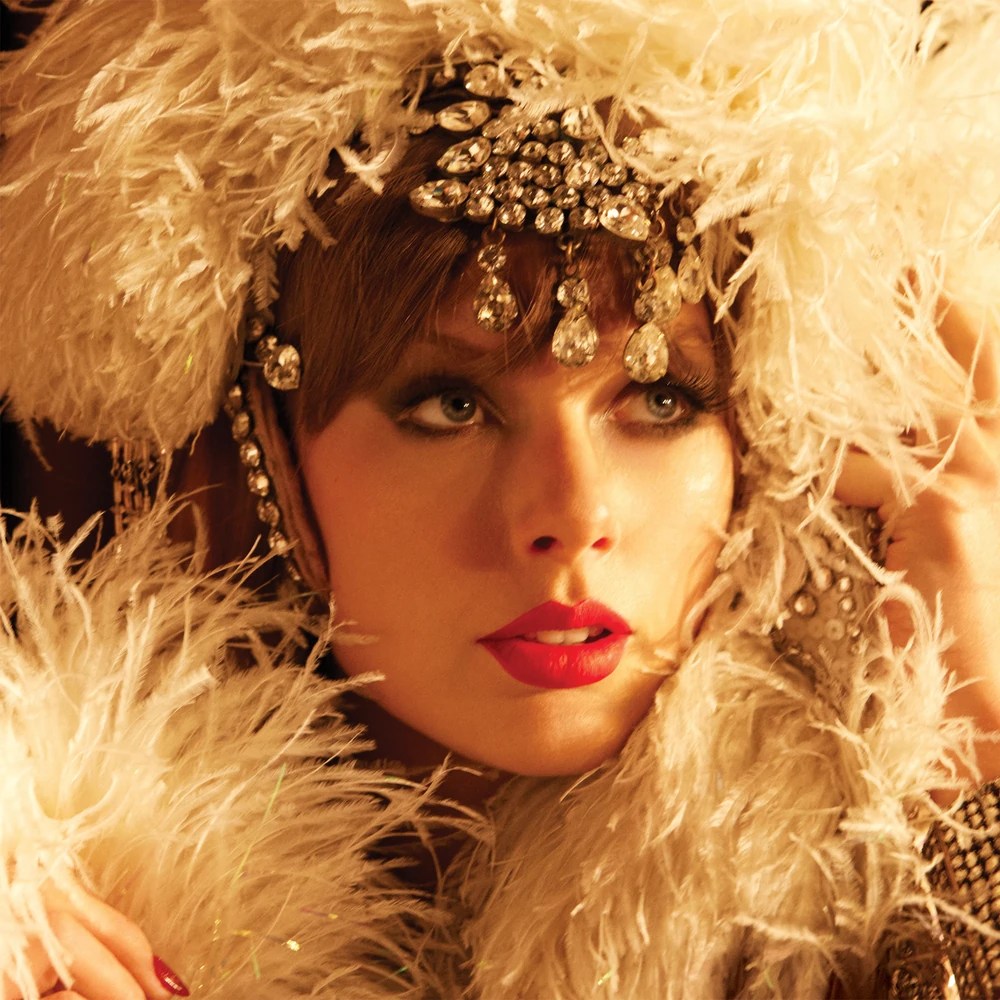
Teased with burlesque-inspired aesthetics, I was excited to see where she would go on this new project and how it would measure up to her discography. The sparkly visuals were a nice contrast to the melancholic atmosphere of her last album, The Tortured Poets Department.
After the album announcement, my excitement waned. Promotion was sparse—just countdowns on her website that led to limited-edition merchandise. With no musical previews, it felt as if she wasn’t trying, making the era feel more promise than delivery.
Taylor’s ability to create remarkable art has always been at the heart of each of her projects. Still, when the silence began to overshadow the music, it made me question what her true intentions were and whether she would deliver a genuine body of work.
However, I still had my hopes intact when I found out long-time collaborators Max Martin and Shellback were returning to work with Taylor; both were responsible for making some of her biggest hits, such as “Blank Space” and “22.”
This decision came at the cost of long-time partner and friend Jack Antonoff, who was noticeably absent from this record. Martin’s and Shellback’s inclusion initially gave me certainty that we were in for another preeminent pop album. But when I listened for the first time, the charismatic feel of their old work was nowhere to be found. And now I’m writing my apology letter to Jack Antonoff.
The overall instrumentation was too minimalist for someone of Swift’s caliber, holding it back from the maximalism it could’ve achieved, especially given the aesthetic of The Life of a Showgirl. Instead of conveying the dazzling energy a showgirl commands, the music feels subdued and more pop-rock than theatrical. The showgirl theme seems to distract from the music itself, masking Taylor’s honest attempt at artistic risk—a risk I know she’s capable of taking.
Taylor hyped up the lyricism before the release, saying, “The Life of a Showgirl is all about infectious pop melodies without losing the quality storytelling of folklore.” In reality, it lacks substance, failing to deliver that glamorous, poetic feel that I expected to see. Some are even so cringeworthy to the point where it makes me wonder if this is the same woman who wrote folklore’s introspective poetry. Sadly, it’s gone, and I can’t seem to find it. I imagine The Life of a Showgirl as a piece of boiled chicken, seasoned with a pinch of promise and a whole lot of lackluster lyrics.
Taylor has written heartbreaking songs, ones that have absolutely shredded my heart to pieces, such as tracks like “epiphany,” and of course, the iconic “All Too Well.” “Eldest Daughter” is the only sad song on The Life of a Showgirl, and it misses its mark by a long shot. It attempts to be raw, but ultimately comes across as if written by ChatGPT from the perspective of a millennial. The song is about how the general public doesn’t reward sincerity, while those closest to you are the ones who truly value your authenticity. I like the idea of the lyrics, specifically the pre-chorus, which suggests that Taylor is a wolf in sheep’s clothing; however, the overall meaning of the song gets lost in the poor songwriting. The chorus feels dated, “I’m not a bad bitch, and this isn’t savage.” She tries to be vulnerable, but it just doesn’t work.
“CANCELLED!” had me skeptical since the announcement of the track. I hate cancel culture, and I knew that if this was coming from Taylor Swift, it could be very hit or miss — and it was beyond a miss. Imagine a terrible version of Lorde’s “Yellow Flicker Beat,” Colleen Ballinger’s “Toxic Gossip Train,” and Ginny from Ginny and Georgia. The result is a confusing and directionless song that lacks cohesion and comes across as random.
It doesn’t fit Taylor at all. On a surface level, it seems like a reputation outtake, teasing trap-rock bits in the beginning, but the lyrical quality falls flat on its face. The subject is also a mess, discussing how she is still friends with people like Brittany Mahomes and other MAGA individuals despite the controversy they receive. It just feels so out of place with Taylor’s morals. It’s the worst song on this album by far, which is upsetting given how edgy the other production factors are.
“Actually Romantic” stood out for all the wrong reasons. The track is about how someone is obsessed with hating Taylor, but she sees their fixation as something almost romantic. The track starts, and fans make many assumptions.
“I heard you call me Boring Barbie when the coke’s got you brave;
High-fived my ex and said you’re glad he ghosted me.”
Many speculated that this track was about singer Charli xcx. In 2024, on her album BRAT, she released a song called “Sympathy is a knife.” It’s about Charli feeling insecure about a really successful woman who makes Charli feel less than. After its release, many assumed it was about Taylor Swift, due to previously dating Matty Healy, who Charli’s husband, George Daniel, is in a band with.
Throughout “Actually Romantic,” there are direct digs at Charli, especially in the line: “Wrote me a song saying it makes you sick to see my face,” echoing Charli’s words on “Sympathy is a knife.” The meaning of her track got lost in translation when Swift heard it, not recognizing that Charli had no ill intent when creating her song.
Swift attempts a comeback, but it’s nowhere near “Look What You Made Me Do” or “Bad Blood.” The melody is catchy, but overall, it’s just an embarrassment for her catalog.
“Wood” references her fianceé, Travis Kelce’s…I’ll just let the title explain itself. The instrumentation is very groovy, sounding exactly like a Michael Jackson song. Past the funkiness, it feels like a Sabrina Carpenter rip-off with its tongue-in-cheek references, but this style just doesn’t fit Taylor, making it an awkward listen.
“Ruin The Friendship” failed to make an impression. It feels more like a Fearless outtake rather than something newly made. The production on this song isn’t anything to write home about; the beat is simple, Taylor’s vocals fall short, and the high school lyrics again demonstrate how far some of these songs are from the aesthetic this album is presenting.
Despite my criticism, the album does offer highlights. “Father Figure,” “Honey,” and “Wi$h Li$t” fall into the same category, having a great chorus and melody, but still suffer from consistent questionable songwriting and production decisions.
“Opalite” is a cheerful anthem, reminiscent of Post Malone’s “Circles.” It’s a high point with its hopeful message and fun, if simplistic, melody. Still, it’s less exciting than it aims to be.
The title and closing track, “The Life of a Showgirl,” features Sabrina Carpenter, who surprisingly outshines Taylor through her persona and energy. It’s also the most “showgirl” a song manages to get on this record. The collaboration is very middle-of-the-road, but a good closer from Taylor, and it manages to stand out over the others.
My favorites on this record, unironically, land next to each other as the first two songs: “The Fate of Ophelia” and “Elizabeth Taylor.”
The lead single, “The Fate of Ophelia,” reminds listeners that Taylor’s creative side still lingers. She’s never been shy about incorporating Shakespearean references into her songs; “The Fate of Ophelia” draws influence from Hamlet, the renowned tragedy written by William Shakespeare. In Hamlet, the character of Ophelia descends into madness over her father, Polonius, whom Hamlet killed. Overwhelming emotions start to consume her and eventually cause her to drown.
Taylor’s interpretation differs, and she received criticism from many who believed she didn’t understand Hamlet. I don’t think that’s the case. Art is subjective, and Taylor uses Ophelia’s death as a metaphor of Travis saving her from “drowning” and loving one another. The prechorus emphasizes the metaphor significantly as she celebrates her man and sings, “You dug me out of a grave and saved my heart from the fate of Ophelia.” It’s a compelling analogy that shows she still has her pen intact. I love it when she tells this story of loving her fiancé, each word creating a movie in my mind. The hook of the melodic chorus immediately pulled me in, showcasing why she chose it as the lead single.
But behind the articulate lyricism, the beat is at a very predictable pace. It doesn’t extend the narrative from the lyrics by any means. Out of all of Swift’s lead singles, it’s definitely the weakest, but not bad by any means. The music video, though, is fantastic and definitely one of her best! I recommend you check it out.“Elizabeth Taylor” is my favorite song on The Life of a Showgirl. Not only is it reputation-coded, but it also retains the storytelling genius that was present in “The Fate of Ophelia.” The track explores Taylor’s love life in the face of fame, drawing parallels between her experiences and those of Elizabeth Taylor.
The song made me recognize how similar Elizabeth Taylor and Swift are in the way they’re under a giant magnifying glass twenty-four-seven. I absolutely love the little references to Elizabeth on the songs, like on the chorus, “I’d cry my eyes violet, Elizabeth Taylor.” And even the little references to fame, like, “You’re only as hot as your last hit baby,” the little details in the lyrics stand out and triumph. Melodically and instrumentally, the song represents everything this album could’ve been. It’s quintessential Taylor with its luxurious, uncut nature entwined with her undying power.
 Soundcheck with Ethan
Leave a comment